

AFTER THIS LESSON
You will be able to
- Read bid/ask and depth
- Estimate average price for size
- Identify the route’s weaker leg
PRACTICE ON REAL SCREENS
IXOR and exchange examples
Interfaces and live market values may change. Use each screen to understand what to verify, not as a current trade setup.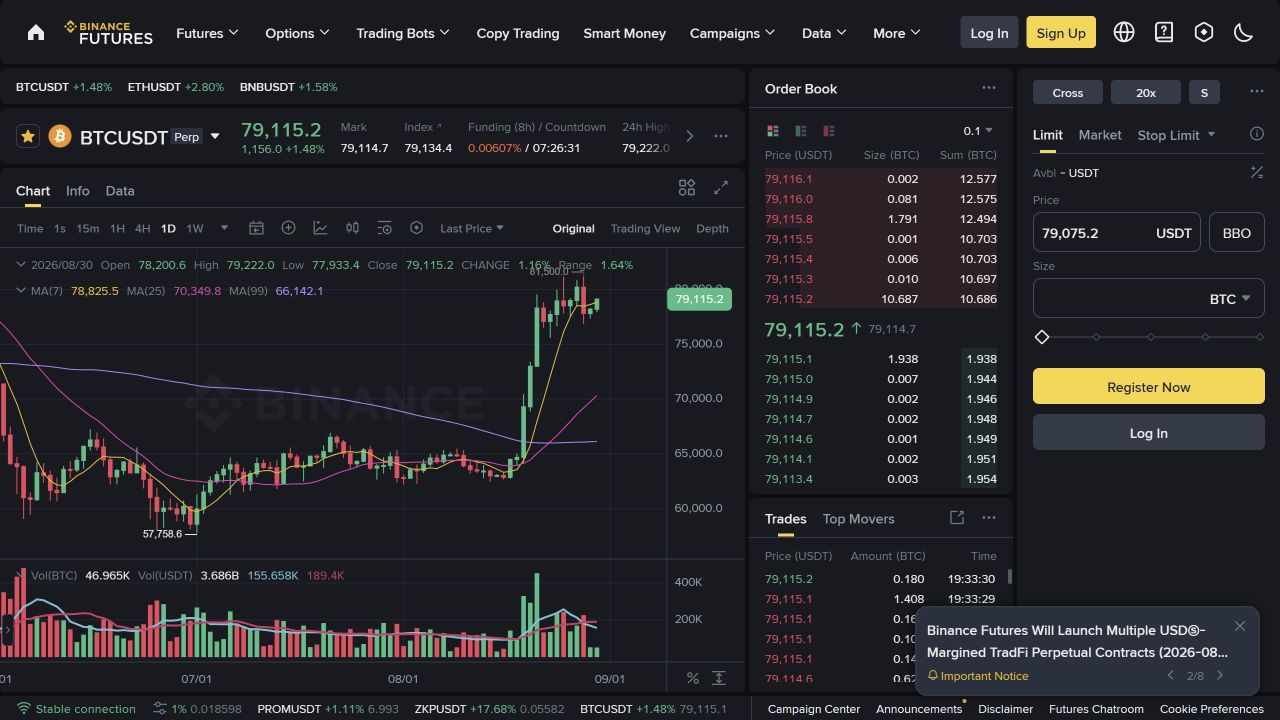
On this public Binance screen, red levels are asks and green levels are bids. The middle price does not guarantee execution for the full size: the average price depends on the levels the order actually consumes. Captured on 30 Aug 2026.
Open public source ↗Top of book
Best bid/ask applies only to the size available at the top level. If your order is larger, execution consumes deeper levels and changes the average price.
- Read the quantity next to the price.
- Check both legs at the same time.
Average price and slippage
Order-book average price estimates execution for a selected size. It is liquidity context and does not replace the signal’s current ROI formula.
- Recalculate spread using expected fill prices.
- Add a buffer for movement between orders.
24h volume and constraints
Daily turnover describes activity over a period, not current depth. Also verify minimum order, tick size, contract size, and position limits.
- Route size is limited by the smaller executable notional.
- Liquidity can disappear faster than the message updates.
PRACTICE
Why the best price is not the position price
You plan to buy 20 tokens for roughly $2,000. The ask book offers 2 tokens at 100, another 8 at 100.5, and another 10 at 101. Calculate the average buy price and decide which price belongs in spread and ROI.
? Show answer
Answer: Average price = (2 × 100 + 8 × 100.5 + 10 × 101) / 20 = 100.7. Use 100.7—not the best price of 100—in spread and ROI. Calculate the second position’s average price for the same token quantity before comparing the markets.
Lesson checklist
- I checked top-level quantity.
- Average prices match my size.
- Contract constraints are verified on both exchanges.
Common mistakes
- Using 24h volume instead of depth.
- Assuming the best price is available for the full size.
Progress is recorded automatically when this section appears on screen.