

AFTER THIS LESSON
You will be able to
- Determine the payer from sign and position
- Understand directional funding Δ
- Check each exchange countdown
- Separate predicted from settled funding
PRACTICE ON REAL SCREENS
IXOR and exchange examples
Interfaces and live market values may change. Use each screen to understand what to verify, not as a current trade setup.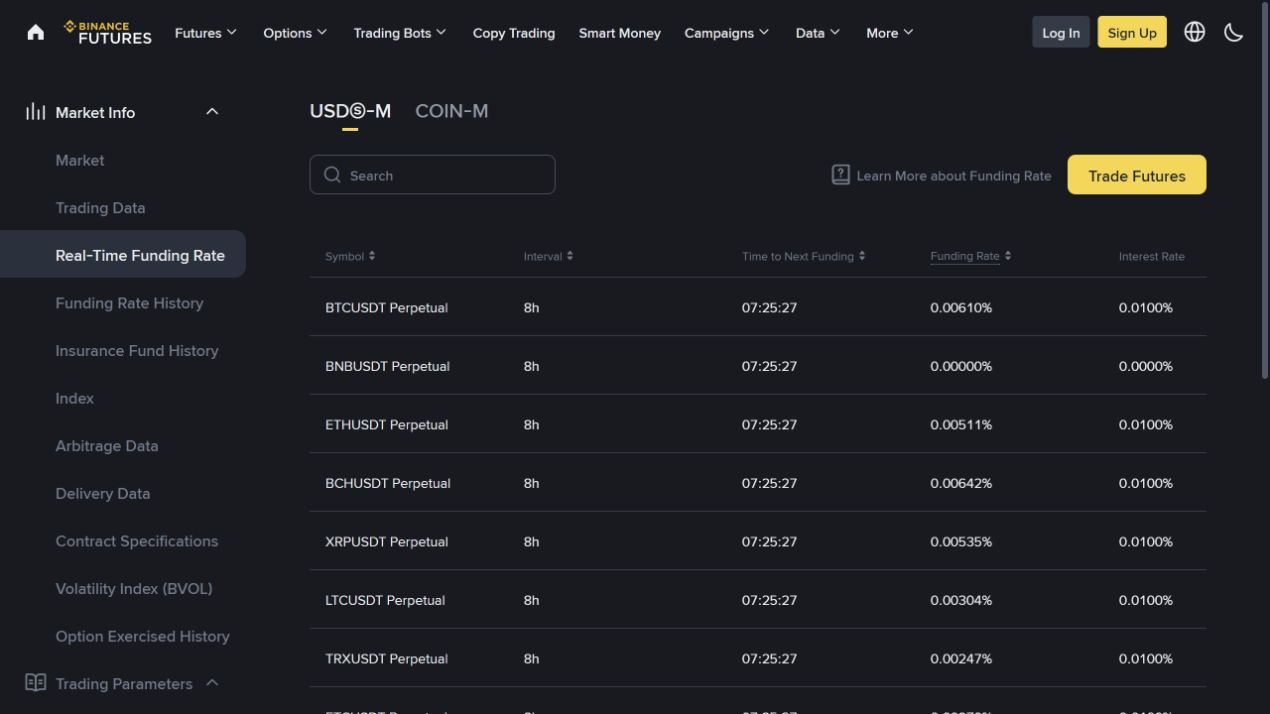
The public Binance table shows why a rate cannot be read without its interval and time to settlement. In futures–futures, verify all three values on both exchanges immediately before entry. Captured on 30 Aug 2026.
Open public source ↗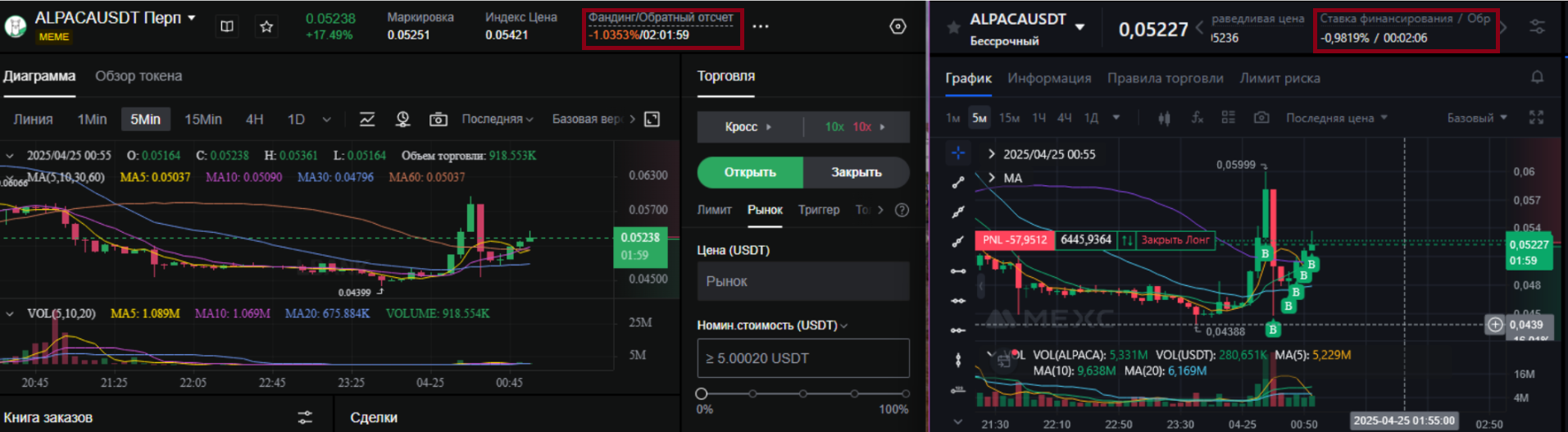
In this archived example, ALPACAUSDT rates are similar across two exchanges while their next settlements are not synchronized. Check sign, rate, interval, and countdown separately for each position immediately before entry.
Sign and direction
When the funding rate is positive, Long pays Short; when it is negative, Short pays Long; at zero, no funding payment is exchanged. Funding applies only to a position that is open at settlement.
- Evaluate both legs separately.
- Do not add rates without considering Long/Short.
Directional funding Δ
In IXOR, funding Δ = Sell/Short funding − Buy/Long funding. The Short cash-flow sign follows its rate, while the Long cash-flow sign is reversed, so both position directions are already encoded in the formula.
A positive raw Δ means the current rate difference favors the selected route; a negative Δ is unfavorable. ROI uses a separate price-weighted funding adjustment, not raw Δ itself.
- Do not take the absolute difference: the sign carries meaning.
- Evaluate Δ together with both position countdowns.
Countdown and intervals
Exchanges may use different intervals and next settlement times. One leg can cross a funding event before the other.
- Check both exchange times immediately before entry.
- Account for intended holding time.
Prediction versus settlement
The current funding rate may update before settlement. IXOR shows the available state and uses it in the estimate but cannot lock the exchange’s future rate.
- Funding does not automatically offset slippage or divergence.
- After exit, reconcile the amounts actually settled.
PRACTICE
Different events
The Short exchange settles in five minutes and the Long exchange in three hours. Describe cash flow for a planned 20-minute hold without counting the second event as settled.
? Show answer
Answer: Only the Short-exchange funding event occurs during the 20-minute hold. With a positive rate, Short receives funding; with a negative rate, Short pays it. The Long-exchange event three hours later has not occurred and must not be included. An exact USDT amount cannot be calculated without the rate sign, rate size, and notional.
Lesson checklist
- I checked the sign against each position.
- I checked both countdowns.
- I do not treat the predicted rate as guaranteed.
Common mistakes
- Treating a positive rate as income for every side.
- Ignoring different settlement times.
Progress is recorded automatically when this section appears on screen.