

AFTER THIS LESSON
You will be able to
- Match notional across both legs
- Prepare a synchronized execution plan
- Define contingency actions in advance
PRACTICE ON REAL SCREENS
IXOR and exchange examples
Interfaces and live market values may change. Use each screen to understand what to verify, not as a current trade setup.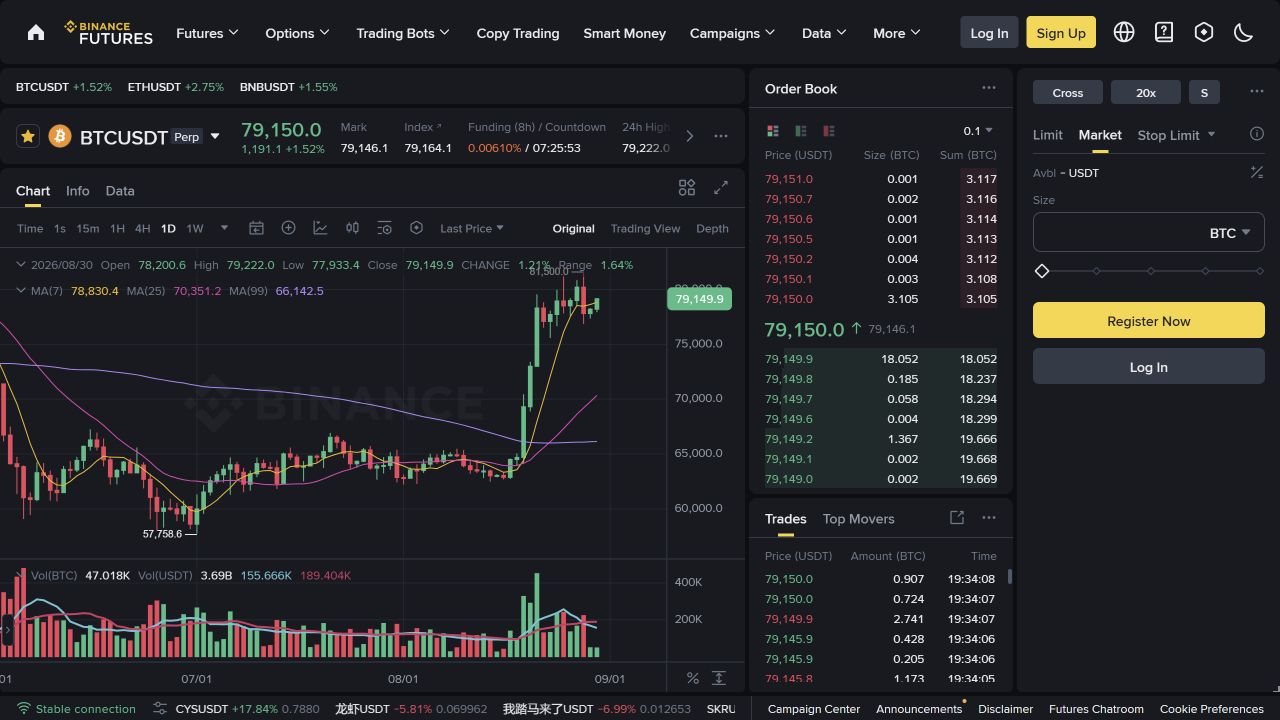
A public Binance Futures screen without account access. A market order consumes available order-book levels: check depth, the maximum acceptable deviation, and the second leg's partial-fill response before submitting it. Captured on 30 Aug 2026.
Open public source ↗Position size
Match position value rather than contract count. Account for contract multiplier, minimum size, tick size, and the weaker leg’s available depth.
- Start with a size executable on both exchanges.
- Do not consume all available margin.
Staged entry: controlling slippage
A planned size can be split into predefined tranches, executing matching Short and Long notionals for each tranche as close together as possible. Example: a 10,000 USDT position per side can be split into four 2,500 USDT tranches.
After each tranche, confirm both fills, compare average prices with the signal, recalculate the remaining spread, and only then proceed. If the price, time, or residual ROI limit is breached, do not open the next tranche.
Staged entry does not guarantee a better final price: if the book does not replenish, the same levels will still be consumed and delay adds movement risk. Its value is limiting error size, observing actual slippage early, and allowing execution to stop.
- Define tranche size before the first order rather than reacting emotionally after price moves.
- For each tranche, match notional and base-token quantity across both exchanges.
- Do not start the next tranche until the previous one is balanced.
Order sequence
Perfect simultaneity does not exist: even two orders sent back-to-back are acknowledged independently. The plan must limit the time and price risk of unhedged exposure.
- Define maximum acceptable price deviation.
- Verify reduce-only for closing orders.
- Do not rely on a market order in a thin book without a risk limit.
Partial fill and exit
If one leg is not fully filled, the structure is temporarily directional. Before entry, choose whether to cancel the remainder, complete it within limits, or reduce the filled leg.
The spread does not have to converge fully to zero. After entry it may narrow, widen, or cross zero and widen with the opposite sign. Define a partial-convergence target in advance and close Short and Long together when it is reached rather than waiting for mandatory full convergence.
- Exit conditions: partial target convergence, loss limit, margin/funding event, or exchange failure.
- Reconcile all four actual fills: entry and exit for both legs.
PRACTICE
Four tranches and a partial fill
The plan is 10,000 USDT on both Short and Long in four 2,500 tranches. The first two fill completely. In the third, Short fills 2,500 while Long fills only 1,500; the remaining Long is now beyond the price limit. Should the fourth tranche be opened, and how should the positions be balanced?
? Show answer
Answer: Do not open the fourth tranche: the previous one is unbalanced and the price limit has been breached. After two tranches both sides are 5,000 USDT; after the third, Short is 7,500 and Long is 6,500. Cancel the unfilled Long remainder and reduce Short by 1,000 USDT to leave a matched 6,500 / 6,500. Then record actual average prices and the reason for stopping.
Lesson checklist
- Leg notionals match after multiplier.
- The size is split into tranches and stop criteria are predefined.
- I have price and time limits between fills.
- Partial-fill and exit actions are defined.
Common mistakes
- Using maximum leverage to reduce capital.
- Opening the next tranche before both sides of the previous one are confirmed.
- Deciding how to handle one leg only after a partial fill.
Progress is recorded automatically when this section appears on screen.